

What Are Scope 1, Scope 2, and Scope 3 Emissions?
Scope 1, Scope 2, and Scope 3 are categories defined by the GHG Protocol, the world’s most widely used greenhouse gas accounting standard. These scopes classify emissions based on ownership, control, and value chain involvement, helping organizations avoid double counting and define accountability.
Scope 1 Emissions: Direct Emissions Under Full Operational Control

Definition (Technical)
Scope 1 emissions are direct greenhouse gas emissions from sources that are owned or controlled by the organization.
Typical Scope 1 Sources
- Fuel combustion in boilers, furnaces, and generators
- Company-owned vehicles
- Industrial processes (e.g., cement calcination)
- Refrigerant leakage (HFCs from AC and chillers)
Why Scope 1 Matters
- Highest level of control
- Immediate reduction potential
- Core focus of operational decarbonization
Scope 2 Emissions: Indirect Emissions from Purchased Energy
Definition (Technical)
Scope 2 emissions are indirect emissions from the generation of purchased energy, primarily electricity, steam, heating, or cooling consumed by the organization.
Scope 2 Accounting Methods
| Method | Description | Key Use |
|---|---|---|
| Location-based | Grid-average emission factors | Reflects real grid conditions |
| Market-based | Contract-specific factors (RECs, PPA) | Reflects procurement choices |
Common Challenges
- Renewable energy claim credibility
- Double counting of certificates
- Inconsistent emission factors
Scope 3 Emissions: The Hidden Carbon Footprint Across the Value Chain
Definition (Technical)
Scope 3 emissions include all other indirect emissions that occur upstream and downstream of a company’s operations but are not owned or controlled by the company.
This is often the largest and most complex emission category.
The 15 Official Scope 3 Categories (GHG Protocol)
Upstream Emissions
- Purchased goods and services
- Capital goods
- Fuel- and energy-related activities
- Upstream transportation and distribution
- Waste generated in operations
- Business travel
- Employee commuting
- Upstream leased assets
Downstream Emissions
- Downstream transportation and distribution
- Processing of sold products
- Use of sold products
- End-of-life treatment of sold products
- Downstream leased assets
- Franchises
- Investments
Why Scope 3 Emissions Are the Most Critical—and Most Ignored
| Aspect | Scope 1 | Scope 2 | Scope 3 |
|---|---|---|---|
| Control level | High | Medium | Low |
| Data availability | High | Medium | Low |
| Emission share | Small | Medium | Largest (up to 70–90%) |
| Complexity | Low | Medium | Very High |
Ignoring Scope 3 emissions often leads to incomplete carbon reporting and high greenwashing risk.
How Companies Calculate Scope 1, 2, and 3 Emissions
Basic Formula:
Emission = Activity Data × Emission Factor
Common Calculation Approaches
- Activity-based (most accurate)
- Spend-based (used when data is limited)
- Supplier-specific data (best practice)
Professional carbon accounting requires verified data, standardized methods, and third-party validation.
Scope Emissions and Net Zero Strategy: What Many Get Wrong
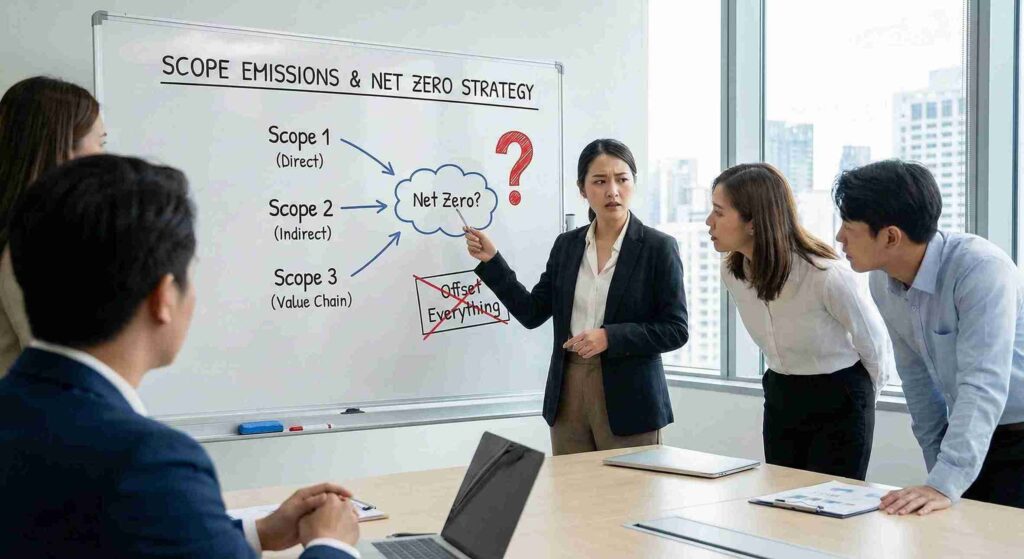
Common mistakes:
- Declaring net zero without Scope 3 coverage
- Over-reliance on carbon offsets
- No supplier engagement strategy
- Poor boundary definition
A credible net zero roadmap always starts with Scope identification and prioritization.
Why Businesses Need Professional Carbon Training and Guidance
Managing Scope 1, 2, and 3 emissions is not just a reporting exercise. It requires:
- Technical understanding
- Regulatory awareness
- Strategic planning
- Verification readiness
This is where professional training and institutional support become essential.
Build Credible Carbon Competence with Mutu Institute
To ensure accurate emissions accounting and avoid compliance risks, organizations need structured training and expert guidance.
Mutu Institute provides:
- Carbon footprint calculation training
- GHG Protocol & ISO 14064 implementation
- Net zero and decarbonization strategy development
- ESG and carbon reporting readiness
In addition, Carbon Nature, the NGO under Mutu Institute, supports:
- Carbon mitigation projects
- Nature-based solutions
- Environmental integrity and sustainability initiatives
Investing in competence today protects your business tomorrow.
Frequently Asked Questions (FAQ)
What is the difference between Scope 2 and Scope 3 emissions?
Scope 2 relates only to purchased energy. Scope 3 covers the entire value chain, including suppliers and product use.
Is Scope 3 mandatory?
Increasingly yes. Many regulations, investors, and global buyers now require Scope 3 disclosure.
Which scope is the hardest to reduce?
Scope 3, due to limited control and reliance on third-party data.
Can a company claim net zero without Scope 3?
Technically possible, but increasingly considered non-credible.
Why should companies work with certified institutions?
Because carbon accounting errors can lead to compliance failure, reputational damage, and financial risk.
Final Insight
Understanding Scope 1, Scope 2, and Scope 3 emissions is the foundation of effective carbon management. Companies that master these concepts early will lead in sustainability, compliance, and long-term competitiveness.
Stay connected with us for more insights, updates, and sustainability knowledge. Follow our official channels:
Instagram: carbonature_
YouTube: CarbonNature
Facebook: Carbon Nature
Website: www.carbonnature.com
For training inquiries, partnership opportunities, or direct assistance, contact us at:
Email: info@carbonnature.com
Phone/WhatsApp: 0819-1880-0012
We’re here to support your journey toward stronger sustainability performance and real climate impact.