

What Is CBAM?
CBAM is a European Union policy that places a carbon price on imported goods equivalent to the carbon costs faced by EU producers under the EU Emissions Trading System (EU ETS).
Why CBAM 2026 Is a Game Changer
The Carbon Border Adjustment Mechanism (CBAM) officially enters its full enforcement phase in 2026, marking a historic shift in how global trade is governed. No longer is carbon merely an environmental concern—it is now a trade determinant, cost factor, and compliance requirement.
For exporters, manufacturers, and multinational companies, CBAM represents both a regulatory risk and a strategic opportunity. Companies that act early can strengthen competitiveness, while those who delay may face rising costs and market barriers.
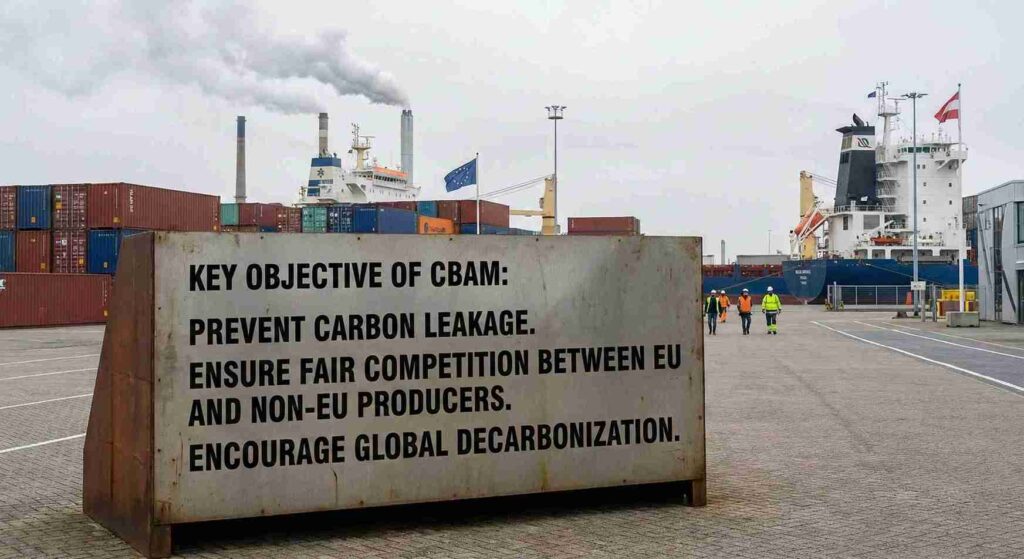
Key Objective of CBAM
- Prevent carbon leakage
- Ensure fair competition between EU and non-EU producers
- Encourage global decarbonization
Sectors Covered in the Initial Phase
- Cement
- Iron and steel
- Aluminum
- Fertilizers
- Electricity
- Hydrogen
CBAM Timeline: From Transition to Full Enforcement
| Phase | Period | Key Obligations |
|---|---|---|
| Transitional Phase | 2023–2025 | Emissions reporting only |
| Full Enforcement | 2026 onward | Purchase of CBAM certificates |
Starting in January 2026, importers must buy CBAM certificates reflecting embedded emissions in their products.
7 Strategic Impacts of CBAM on Global Trade
1. Carbon Becomes a Trade Currency
Carbon intensity directly affects product pricing and market access.
2. Higher Compliance Costs for Exporters
Companies without verified emissions data face default (higher) carbon values.
3. Mandatory Emissions Measurement
Accurate MRV (Measurement, Reporting, Verification) becomes essential.
4. ESG Performance Gains Legal Weight
CBAM links sustainability performance with customs and taxation.
5. Supply Chain Transparency Is No Longer Optional
Suppliers must provide emissions data or risk losing EU market access.
6. Increased Demand for Carbon Competence
Professionals trained in carbon accounting and CBAM compliance are in high demand.
7. Opportunity for Early Movers
Organizations prepared for CBAM can negotiate better contracts and pricing.
CBAM vs Traditional Carbon Tax
| Aspect | CBAM | Traditional Carbon Tax |
| Scope | Imports to EU | Domestic only |
| Basis | Embedded emissions | Fuel or activity |
| Trade Impact | High | Limited |
| Verification | Mandatory third-party | Often self-reported |
What Businesses Must Prepare Before 2026
- Carbon footprint calculation per product
- CBAM-compliant emissions reporting
- Supplier emissions data integration
- Internal carbon management systems
- Trained sustainability and compliance teams
This is where structured training and expert guidance become critical.
Why CBAM Training Matters More Than Ever
CBAM compliance is not just about reporting—it requires technical understanding, regulatory interpretation, and strategic decision-making.
Through Mutu Institute’s CBAM & Carbon Management Training, organizations can:
- Understand CBAM regulatory mechanics
- Build internal carbon accounting capability
- Reduce compliance risks and costs
- Strengthen ESG and export readiness
Mutu Institute is further supported by its environmental NGO, Carbon Nature, which focuses on carbon education, climate action, and sustainability implementation—bridging regulation with real impact.
Soft Insight: Companies that invest in carbon competence today are the ones that will dominate low-carbon trade tomorrow.
Who Should Take Action Now?
- Export-oriented manufacturers
- Sustainability & ESG managers
- Trade compliance teams
- Government & policy stakeholders
- Consultants and auditors
CBAM readiness is no longer optional—it is a strategic necessity.
Prepare your organization for CBAM 2026 with confidence.
Join CBAM & Carbon Management Training at Mutu Institute and gain practical knowledge, regulatory clarity, and strategic advantage in the new era of carbon-based trade.
Together with Carbon Nature NGO, Mutu Institute supports businesses not only to comply—but to lead.
Frequently Asked Questions (FAQ)
What happens if a company ignores CBAM in 2026?
Companies may face higher import costs, penalties, or restricted access to the EU market.
Is CBAM applicable outside the EU?
CBAM applies to all non-EU exporters selling covered products into the EU.
Can companies reduce CBAM costs?
Yes. Lowering embedded emissions and providing verified data can significantly reduce CBAM certificate costs.
Does CBAM replace carbon tax?
No. CBAM complements the EU ETS and aligns import costs with EU carbon pricing.
How can Mutu Institute help?
Mutu Institute provides structured training, technical guidance, and carbon strategy support aligned with CBAM requirements.
Stay connected with us for more insights, updates, and sustainability knowledge. Follow our official channels:
Instagram: carbonature_
YouTube: CarbonNature
Facebook: Carbon Nature
Website: www.carbonnature.com
For training inquiries, partnership opportunities, or direct assistance, contact us at:
Email: info@carbonnature.com
Phone/WhatsApp: 0819-1880-0012
We’re here to support your journey toward stronger sustainability performance and real climate impact.