

Sustainability Depends on People, Not Only Policies
Sustainable forest management in Indonesia is no longer defined solely by regulations, forest zoning maps, or conservation targets. It is increasingly measured by how effectively policies are implemented on the ground. Despite stronger legal frameworks and improved monitoring systems, Indonesia continues to face deforestation, land-use conflicts, biodiversity loss, and climate-related disasters. At the center of these challenges lies a decisive factor that is often underestimated: human resource capacity.
Forests are managed by people—government officers, concession holders, auditors, community groups, NGOs, and private-sector actors. When their competencies are insufficient, even the most comprehensive sustainability strategies struggle to deliver results. This article explores the current challenges of sustainable forest management in Indonesia and explains why investment in forestry human resource development has become one of the most strategic solutions for long-term impact.
Current State of Indonesia’s Forests: Progress Under Pressure
Indonesia remains one of the countries with the largest forest areas in the world. In 2024, forest cover was estimated at approximately 95.5 million hectares, representing around 51.1 percent of national land area. This figure reflects years of policy reform, moratoriums on primary forest clearing, and enhanced monitoring efforts.
However, these gains are fragile. Net deforestation in 2024 reached an estimated 175,400 hectares, largely occurring in secondary forests. While this number is lower than historical peaks, it highlights a critical reality: sustainable forest management remains uneven, especially at the implementation level.
The challenge is no longer about the absence of rules, but about the capacity to enforce, monitor, and adapt those rules in complex and dynamic landscapes.
Key Drivers of Deforestation and Forest Degradation
1. Agricultural Expansion and Plantation Development
Land clearing for agriculture—particularly oil palm plantations—continues to exert pressure on forested areas. Although sustainability commitments have improved corporate practices, gaps in monitoring, verification, and local enforcement still allow forest conversion to occur, especially in remote regions.
2. Illegal Logging and Mining Activities
Illegal logging and unlicensed mining remain persistent problems within forest zones. These activities are often driven by weak supervision, limited field capacity, and insufficient understanding of legal boundaries at the operational level. In many cases, violations occur not because regulations are unclear, but because enforcement personnel lack adequate technical and investigative skills.
3. Forest and Peatland Fires
Forest fires—particularly in peatland ecosystems—continue to cause environmental damage and carbon emissions. Fire prevention and response require trained personnel who understand hydrology, early-warning systems, and community-based fire management. Where human resource capacity is weak, responses are often reactive rather than preventive.
Environmental Disasters and Biodiversity at Risk
Recent climate-related disasters have reinforced the link between forest condition and ecological resilience. Severe flooding in North Sumatra in late 2025 damaged thousands of hectares of forest and intensified threats to critically endangered species, including the Tapanuli orangutan.
These events demonstrate that deforestation, poor land management, and climate change are interconnected risks. Sustainable forest management must therefore integrate ecosystem-based approaches, biodiversity protection, and climate adaptation—tasks that demand multidisciplinary skills and continuous learning among forestry professionals.
Governance, Enforcement, and Land-Use Conflicts
The Indonesian government has increased enforcement against illegal forest occupation, including reclaiming forest areas from unlicensed palm oil and mining operations. While these actions represent progress, they also reveal deeper governance challenges.
Land-use conflicts often involve overlapping permits, unclear tenure, and competing economic interests. Resolving these disputes requires more than legal authority. It demands competence in mediation, stakeholder engagement, spatial analysis, and policy interpretation—skills that are still unevenly distributed across forestry institutions.
Why Human Resource Competence Is the Missing Link
Forestry Governance Is Increasingly Complex
Modern sustainable forest management involves regulatory compliance, certification schemes, climate reporting, biodiversity safeguards, and social inclusion. Forestry professionals must navigate national laws, international standards, and local realities simultaneously.
When human resource capacity is limited, implementation gaps emerge. Policies remain on paper, audits generate repeated findings, and sustainability commitments lose credibility.
Skills Gaps Across the Sector
Many forestry organizations and community groups still lack personnel with updated expertise in:
- Remote sensing and satellite-based forest monitoring
- Geographic Information Systems (GIS) and spatial analysis
- Forest certification and sustainability auditing
- Environmental and social impact assessment
- Adaptive management under climate uncertainty
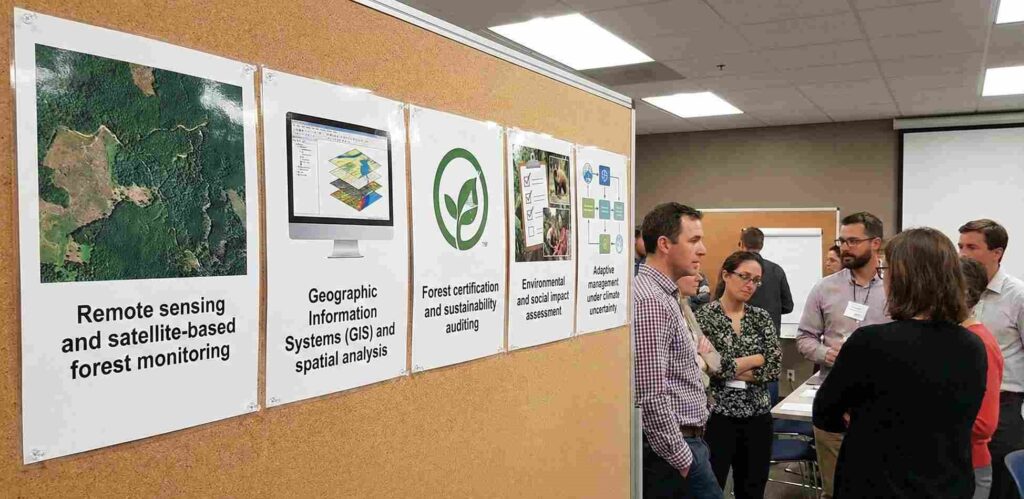
Without these competencies, sustainable forest management initiatives struggle to deliver measurable outcomes.
Capacity Building as a Strategic Investment
Strengthening Compliance and Accountability
Targeted training programs help forestry personnel translate complex regulations into consistent field practices. Skilled human resources improve compliance monitoring, reduce audit non-conformities, and support transparent reporting across the forestry value chain.
Improving Forest Monitoring and Decision-Making
Capacity building in remote sensing, GIS, and forest inventory techniques enables early detection of illegal activities and more accurate assessment of forest change. These capabilities support data-driven decision-making rather than reactive enforcement.
Empowering Community-Based Forest Management
Indonesia’s social forestry (perhutanan sosial) program demonstrates that community involvement can enhance sustainability when supported by adequate skills. Training community groups in forest planning, monitoring, and sustainable livelihoods reduces dependence on destructive practices and strengthens local stewardship.
The Role of Professional Training Institutions
Sustainable forest management requires continuous learning. As regulations evolve and environmental risks increase, forestry professionals must regularly update their competencies. This is where specialized training institutions play a critical role.
Mutu Institute supports forestry stakeholders through structured training programs focused on audit readiness, sustainability standards, forest governance, and technical capacity development. These programs are designed not only to meet compliance requirements but to build practical skills applicable in real-world forestry operations.
For organizations seeking broader environmental impact, Carbon Nature, Mutu Institute’s NGO service arm, provides support in conservation initiatives, carbon projects, and community-based sustainability programs. This integrated approach enables stakeholders to align forest management with climate action and social development goals.
Rather than offering one-time solutions, capacity building creates long-term value by strengthening institutions and people.
Sustainable Forests Require Sustainable Skills
The challenges of sustainable forest management in Indonesia extend beyond deforestation statistics and regulatory frameworks. They are deeply rooted in human capacity—the knowledge, skills, and professionalism of those managing forest landscapes.
Investing in forestry human resource development improves governance, reduces environmental risk, and enhances resilience against climate and socio-economic pressures. Capacity building ensures that sustainability strategies move beyond intention and become effective action on the ground.
For forestry organizations, NGOs, and community groups, strengthening human resources is no longer optional. It is a strategic necessity for protecting Indonesia’s forests and securing their value for future generations.
If your organization is committed to sustainable forest management, now is the time to invest in people. Join Mutu Institute’s forestry training programs to strengthen audit readiness, governance, and technical competence.
For conservation, carbon, and community-based initiatives, Carbon Nature is ready to collaborate in building impactful, science-based sustainability solutions.
Develop skills. Strengthen governance. Protect forests—starting with people.
Stay connected with us for more insights, updates, and sustainability knowledge. Follow our official channels:
Instagram: carbonature_
YouTube: CarbonNature
Facebook: Carbon Nature
Website: www.carbonnature.com
For training inquiries, partnership opportunities, or direct assistance, contact us at:
Email: info@carbonnature.com
Phone/WhatsApp: 0819-1880-0012
We’re here to support your journey toward stronger sustainability performance and real climate impact.