

Indonesia’s palm oil industry is entering one of its most dynamic phases in recent years. In 2025, both domestic consumption and export activity recorded significant increases, reflecting strengthened demand, competitive market positioning, and rising global prices. Data from the Indonesian Palm Oil Association (GAPKI) and the Central Statistics Agency (BPS) highlight how the sector continues to play a central role in supporting national revenue and industrial expansion.
This article explores key developments in domestic demand, export performance, global pricing trends, and corporate responses. It also provides industry insights valuable for professionals, policymakers, and sustainability-focused organizations.
Domestic Demand Reaches New Highs
Between January and September 2025, Indonesia recorded a sharp increase in domestic consumption of crude palm oil (CPO), reaching 18,460 tons, up 5.1 percent from last year’s 17,550 tons. This steady growth underscores CPO’s expanding role across multiple industries.
Biodiesel Sector Dominates Local Consumption
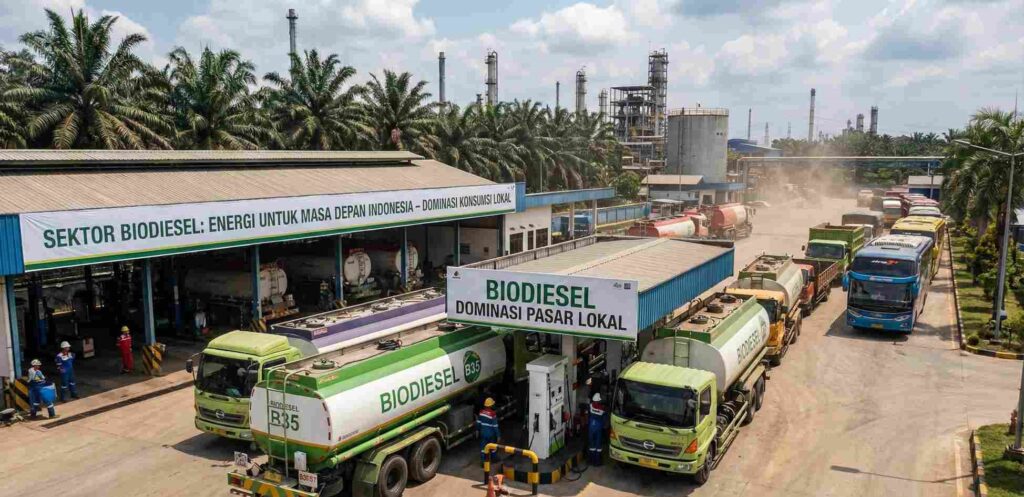
The biodiesel industry continues to serve as Indonesia’s core domestic consumer of palm oil. In 2025, biodiesel accounted for:
- 9,414 tons of CPO
- 51 percent of total domestic consumption
This reflects the government’s sustained commitment to the biodiesel mandate and the expansion of renewable energy programs. The sector’s stability further strengthens Indonesia’s position as a global leader in palm-based biofuels.
Expanding Use in Food Manufacturing
The food industry absorbed 7,372 tons or 40 percent of total domestic CPO use. This segment continues to grow due to rising demand for packaged foods, culinary oils, and processed food ingredients. As consumer markets expand across Southeast Asia, food-related CPO applications are expected to experience steady upward momentum.
Oleochemical Sector Shows Stable Growth
Oleochemical products, used across health, beauty, and industrial manufacturing, accounted for 1,674 tons or 9 percent of domestic consumption. The segment contributes to the diversification of palm oil downstream industries, supporting value-added product development and technological innovation.
Corporate Momentum: BMA Eyes Doubling of Sales
National palm oil producer Bumi Makmur Anugerahagung (BMA) reported strong confidence in 2025, driven by rising domestic demand. Based on first-half sales, the company expects sales volume to double compared with 2024.
Director Cheny Canliarta emphasized two strategic directions:
- Expansion of production capacity
- Product diversification for stronger market resilience
BMA’s outlook reflects broader trends in the industry, where producers are enhancing efficiency, strengthening sustainability commitments, and preparing for long-term competitiveness.
“We are committed to supporting a sustainable and competitive palm oil supply chain,” Cheny stated, pointing to growing emphasis on traceability, responsible sourcing, and environmental compliance.
Indonesia Strengthens Its Position in Global Markets
Indonesia remains the world’s largest producer and exporter of palm oil, and 2025 further solidified this leadership. BPS data show significant improvements in both export volume and revenue.
Export Value Rises 25.7 Percent
As of October 2025, palm oil exports recorded a 25.7 percent increase in value compared with the same period in 2024. This surge reflects not only higher shipment volumes but also improved global prices.
From January to October 2025, Indonesia exported:
- $20.2 billion worth of crude and processed palm oil
- Contributing 9.05 percent to total non-oil-and-gas exports
This underscores the sector’s substantial role in supporting Indonesia’s foreign exchange earnings.
Export Volumes Reach 19.49 Million Tons
Export volumes showed steady growth, rising 7.8 percent to 19.49 million tons, up from 18.08 million tons last year. October shipments alone reached 1.91 million tons, reflecting stable global demand.
Key export destinations include India, China, the European Union, Pakistan, and various African markets.
Higher Global Prices Boost Revenue
GAPKI attributed export value growth to improved global pricing:
- Average CPO price (Jan–Sept 2025): $1,210 per ton CIF Rotterdam
- Same period in 2024: $1,020 per ton
- October 2025 price: $1,045.04 per ton, up 0.8 percent month-on-month
Higher prices have strengthened revenue streams and encouraged producers to invest in sustainability and production efficiency.
Market Implications and Industry Outlook
The 2025 performance illustrates a maturing industry that balances domestic demand expansion with global market leadership. Key implications include:
- Stronger biodiesel policies continue to support long-term CPO absorption.
- Higher global demand provides incentives for improved sustainability certification, including ISPO compliance.
- Corporate competitiveness is rising, with leading companies pursuing innovation, technology adoption, and value-added product development.
- Market diversification is reducing reliance on single export destinations.
With momentum in both domestic and international markets, the outlook for 2026 remains positive—especially for companies that strengthen operational standards and embrace sustainability frameworks.
Strengthening Sustainability and Compliance Through Training
As demand rises, industry stakeholders face increasing expectations for transparency, compliance, and sustainable practices. Organizations involved in production, processing, and export must continuously update their knowledge of regulatory standards, environmental requirements, and ESG frameworks.
To support this transition, Mutu Institute provides specialized training programs, including:
- ISPO Refreshment Training (Permentan No. 33/2025)
- Sustainability and supply chain compliance
- Quality management and certification readiness
These programs help companies maintain competitiveness, improve audit readiness, and align with national sustainability objectives.
Supporting Environmental Initiatives Through Carbon Nature
Mutu Institute also operates Carbon Nature, an NGO dedicated to environmental preservation and climate resilience. Carbon Nature focuses on:
- Community-based conservation programs
- Ecosystem restoration
- Carbon footprint reduction initiatives
- Private sector sustainability partnerships
With rising interest in green investment and carbon accounting, Carbon Nature provides organizations with a platform to deepen their environmental contributions and strengthen their ESG profile.
Strengthen your organization’s capabilities in sustainability, compliance, and palm oil supply chain management.
Join Mutu Institute’s training programs, including our ISPO Refreshment Training aligned with Permentan No. 33/2025, and prepare your team for stronger performance and certification readiness.
For companies seeking deeper environmental engagement, explore our NGO initiatives at Carbon Nature and collaborate with us to support impactful conservation efforts.
Enhance your competitiveness. Strengthen your sustainability journey. Connect with Mutu Institute and Carbon Nature today.
Stay connected with us for more insights, updates, and sustainability knowledge. Follow our official channels:
Instagram: carbonature_
YouTube: CarbonNature
Facebook: Carbon Nature
Website: www.carbonnature.com
For training inquiries, partnership opportunities, or direct assistance, contact us at:
Email: info@carbonnature.com
Phone/WhatsApp: 0819-1880-0012
We’re here to support your journey toward stronger sustainability performance and real climate impact.