

The landscape of Indonesian business is undergoing a seismic shift. As we approach 2025, the Carbon Economic Value (Nilai Ekonomi Karbon / NEK) is transitioning from a policy concept to a core financial reality. For forward-thinking leaders, this represents more than a compliance hurdle; it is a gateway to the new green economy.
In this guide, we break down how NEK 2025 impacts your bottom line and how to pivot your strategy to turn carbon liabilities into strategic assets.
Understanding NEK 2025: More Than Just “Green” Policy
The NEK 2025 framework is Indonesia’s primary engine for achieving its Net Zero Emissions (NZE) targets by 2060. By assigning a literal price to carbon, the government is incentivizing a shift toward low-carbon operations.
Unlike previous years where sustainability reporting was largely voluntary or narrative-based, 2025 marks the era of mandatory carbon accounting for priority sectors. The mechanism relies on three pillars:
- Carbon Trading: A “cap-and-trade” system where high emitters buy allowances.1
- Carbon Offsetting: Investing in external projects (like those managed by Carbon Nature NGO) to neutralize your footprint.
- Result-Based Payments (RBP): Financial rewards for verified emission reductions.
The Economic Shift: Business Readiness at a Glance
How does your current operation stack up against the upcoming 2025 requirements? Use the table below to evaluate your organizational readiness.
| Aspect | Pre-2025 Landscape | NEK 2025 Requirement | Business Impact |
| Data Status | Optional/Estimated | Mandatory & Verified | High: Requires robust MRV systems |
| Carbon Costs | Externalized (No cost) | Internalized (Line item) | Financial: Impacts Opex/Capex |
| Market Role | CSR/Philanthropy | Strategic Asset | Revenue: Monetization of credits |
| Regulatory Risk | Low (Reputational) | High (Legal/Financial) | Compliance: License to operate |
| Reporting | Narrative/Qualitative | Data-Driven/Quantitative | Governance: Investor transparency |
Nature-Based Solutions: Indonesia’s Strategic Edge
Indonesia possesses a “green goldmine” through its vast forests and peatlands. Under the NEK framework, Nature-Based Solutions (NBS) are not just environmental projects; they are high-integrity carbon credit factories.
Through Carbon Nature, the NGO wing of Mutu Institute, organizations can bridge the gap between regulatory theory and field-based impact. By developing credible carbon projects that prioritize biodiversity and community welfare, businesses can secure high-quality offsets that meet both Indonesian and international standards.
The Hidden Risk: The “Competency Gap”
The biggest threat to Indonesian businesses in 2025 isn’t the carbon tax—it’s the lack of internal expertise. To navigate this new economy, your team needs:
- Carbon Auditors to ensure data integrity.2
- MRV Specialists to handle Measurement, Reporting, and Verification.
- ESG Strategists to integrate carbon value into the corporate vision.
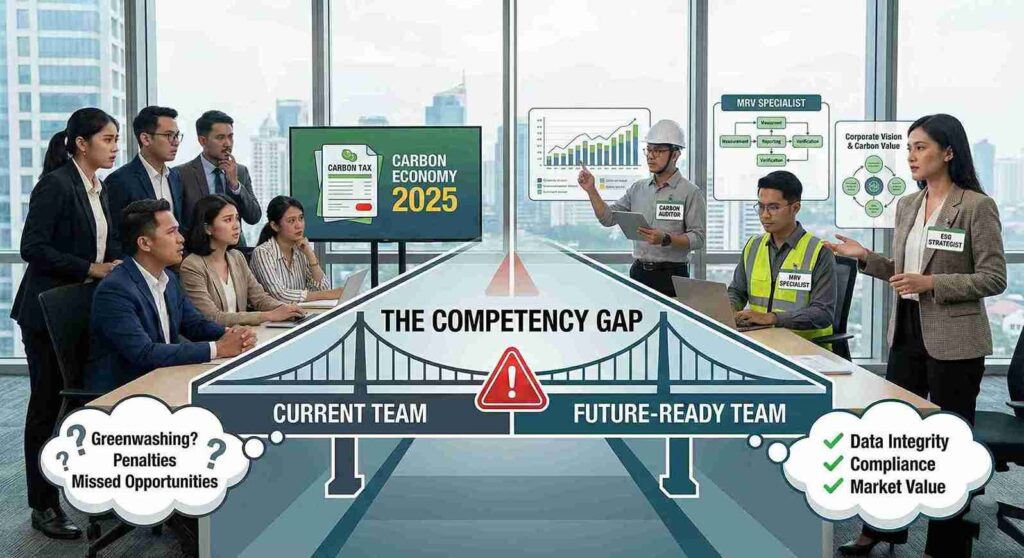
Without these roles, companies risk greenwashing allegations, financial penalties, and missed opportunities in the domestic carbon market.
Take the Lead: Professional Training with Mutu Institute
Don’t wait for 2025 to disrupt your operations. Mutu Institute, supported by the hands-on expertise of Carbon Nature NGO, offers the gold standard in carbon economy capacity building.
Whether you need to master GHG Inventorying, understand NEK legal compliance, or learn how to monetize carbon credits, our practitioner-led programs provide the tools you need to lead.
Frequently Asked Questions (FAQ)
Q1: Which sectors are prioritized under NEK 2025?
Initially, energy, forestry, and waste management sectors face the strictest regulations, with manufacturing and transportation following closely.
Q2: How can carbon credits become a revenue stream?
If your company reduces emissions below its government-assigned “cap,” you can sell your excess “allowance” or verified credits to other companies on the carbon exchange.3
Q3: What is the role of Carbon Nature NGO?
Carbon Nature acts as the technical and environmental arm, ensuring that carbon projects are ecologically sound, socially responsible, and compliant with NEK standards.
Q4: Is international certification (like Verra or GS) enough for Indonesia?
While international standards are respected, alignment with the National Registry System (SRN) is mandatory for compliance within the Indonesian NEK framework.
Stay connected with us for more insights, updates, and sustainability knowledge. Follow our official channels:
Instagram: carbonature_
YouTube: CarbonNature
Facebook: Carbon Nature
Website: www.carbonnature.com
For training inquiries, partnership opportunities, or direct assistance, contact us at:
Email: info@carbonnature.com
Phone/WhatsApp: 0819-1880-0012
We’re here to support your journey toward stronger sustainability performance and real climate impact.