

Indonesia’s cocoa sector is entering a critical transformation phase as global demand shifts toward sustainable, traceable, and high-quality agricultural products. Responding to this momentum, the Ministry of National Development Planning (Bappenas), the Embassy of France in Indonesia, and the French agricultural research organization CIRAD officially launched the INDOCACAO Project in Jakarta on 18 September. Funded by the French Ministry of Europe and Foreign Affairs through the Equipe France Fund and PT Permodalan Nasional Madani (PNM), INDOCACAO will be implemented from 2025 to 2027 with a strong focus on small-scale cocoa producers, women, and youth.
Designed as a research-driven, innovation-oriented, and partnership-based initiative, INDOCACAO aims to strengthen Indonesia’s cocoa value chain from farm to export markets. The project is fully aligned with Indonesia’s National Long-Term Development Plan (RPJPN) 2025–2045 and National Medium-Term Development Plan (RPJMN) 2025–2029, positioning cocoa as a strategic commodity for downstream industrialisation, farmer welfare, and sustainable economic growth.
Cocoa as a Strategic Commodity in Indonesia’s Development Agenda
According to Bappenas, cocoa plays a strategic role in Indonesia’s agricultural and industrial future. Beyond its contribution to export revenues, the cocoa sector supports rural livelihoods, promotes agro-industry development, and strengthens regional economies. However, the sector continues to face structural challenges, including low productivity, inconsistent quality, limited access to finance, climate risks, and weak integration into global value chains.
Leonardo A.A. Teguh Sambodo, Deputy for Food, Natural Resources, and Environment at Bappenas, emphasized that achieving national development targets requires collaboration across ministries, academia, private sector actors, development partners, and researchers. Through INDOCACAO, Indonesia demonstrates its commitment to building a competitive, inclusive, and sustainable cocoa ecosystem supported by research, innovation, and international cooperation.
A Strategic France–Indonesia Partnership in Agriculture
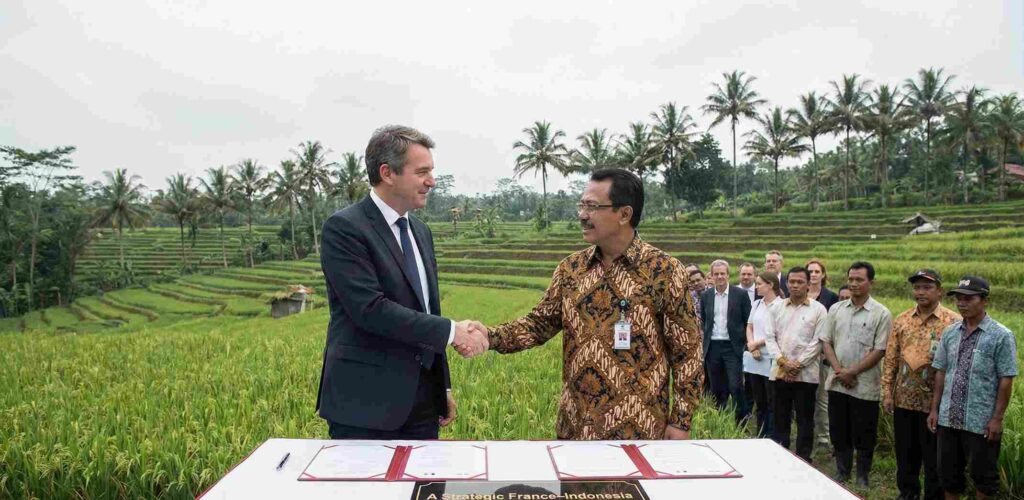
INDOCACAO is also a concrete manifestation of the deepening partnership between France and Indonesia in the agricultural and agro-industrial sectors. The project aligns with the bilateral agreement signed on 29 May 2025 at Merdeka Palace, witnessed by President Prabowo Subianto and French President Emmanuel Macron during the French President’s state visit to Indonesia.
French Ambassador to Indonesia Fabien Penone highlighted that INDOCACAO is designed and implemented in close collaboration with Indonesian authorities, ensuring relevance, ownership, and measurable impact. By modernising Indonesia’s cocoa industry and unlocking its export potential, the project contributes to shared economic, environmental, and social objectives set by both governments.
CIRAD’s Role and Multi-Stakeholder Collaboration
CIRAD plays a central role in ensuring scientific and technical coordination within INDOCACAO. The project brings together a diverse ecosystem of Indonesian partners, including:
- Agency for Agricultural Assembly and Modernisation (BRMP)
- Indonesian Coffee and Cocoa Research Institute (Puslitkoka)
- Stiper Agricultural Institute (INSTIPER)
- Private sector actors such as the Bean to Bar Chocolate Association of Indonesia and JIKA Chocolates
- Farmer cooperatives and local extension networks
This multi-stakeholder approach ensures that research outputs are translated into practical solutions, capacity building, and market-oriented innovations that directly benefit farmers and cocoa entrepreneurs.
Three Pillars of the INDOCACAO Project
1. Establishing a Technical Centre for Sustainable Cocoa Farming
The first pillar of INDOCACAO is the establishment of a technical centre for sustainable cocoa farming, with pilot initiatives in Java and Sulawesi. This centre will serve as a hub for applied research, technical assistance, and farmer-oriented innovation.
Key activities include:
- Consultancy and technical training for 480 cocoa sector managers
- Extension services reaching nearly 20,000 farmers through PNM’s nationwide programmes
- Access to microloans via PNM to support investment in farm inputs, equipment, and post-harvest infrastructure
- Innovative learning models, including educational gardens, online training platforms, and mobile applications
By combining finance, knowledge, and technology, the technical centre aims to accelerate productivity improvements while promoting sustainable farming practices.
2. Strengthening the Cocoa Value Chain and Export Competitiveness
The second pillar focuses on enhancing Indonesia’s cocoa value chain by improving quality, consistency, and market access. This includes:
- Dissemination of good post-harvest practices to reduce losses and improve bean quality
- Support for certification schemes aligned with international sustainability and traceability standards
- Development of commercial partnerships with international chocolate producers
- Professional training in organoleptic analysis to promote flavour profiling and premium cocoa positioning
Through these efforts, INDOCACAO seeks to shift Indonesia’s role from a raw material supplier toward a producer of high-value, differentiated cocoa products.
3. Ecological Resilience and Climate-Smart Cocoa Production
Sustainability and resilience form the third core pillar of INDOCACAO. The project promotes:
- Agroforestry systems and reforestation initiatives to protect biodiversity and soil health
- Development of disease- and climate-resistant cocoa varieties
- Early warning systems for droughts and floods
- Cocoa production under the principle of zero imported deforestation, aligned with European regulatory standards
These measures ensure that productivity gains are achieved without compromising environmental integrity, positioning Indonesian cocoa as a responsible and future-ready commodity.
Empowering Women and Youth
A defining feature of INDOCACAO is its strong commitment to social inclusion. The project targets women and youth as key drivers of innovation and sustainability in the cocoa sector.
- 50 per cent of direct beneficiaries will be women, receiving training in leadership, cooperative management, and entrepreneurship
- Young small-scale farmers will receive tailored technical support and innovation-focused capacity building
- Access to finance for youth will be facilitated through PNM, where 99 per cent of clients are young people
By empowering women and youth, INDOCACAO strengthens not only productivity but also social resilience and generational renewal in Indonesia’s rural economy.
Opportunities for Capacity Building and Professional Training
As Indonesia’s cocoa sector modernises, the demand for skilled professionals, internal auditors, sustainability officers, and cooperative leaders continues to grow. Structured training, practical knowledge, and international best practices are becoming essential assets.
MUTU Institute supports this transformation by providing professional training programmes, technical refreshment courses, and capacity-building services tailored to agribusiness, sustainability, and certification needs. Our programmes are designed for practitioners, cooperatives, NGOs, and private sector actors seeking to strengthen compliance, performance, and impact across agricultural value chains.
For organisations involved in cocoa, agroforestry, and sustainable agriculture initiatives such as INDOCACAO, continuous learning is a strategic investment that delivers long-term value.
Supporting Sustainability Through Carbon Nature
Beyond training, Mutu Institute also operates an NGO service under Carbon Nature, focusing on environmental sustainability, carbon management, and nature-based solutions. Carbon Nature supports projects related to agroforestry, reforestation, biodiversity protection, and carbon measurement, reporting, and verification.
For stakeholders in the cocoa sector, Carbon Nature provides strategic support to:
- Integrate climate-smart agriculture practices
- Align projects with international sustainability and carbon standards
- Strengthen environmental credibility and market acceptance
This integrated approach helps organisations and cooperatives translate sustainability commitments into measurable and credible outcomes.
Building a Competitive and Inclusive Cocoa Future
INDOCACAO represents a forward-looking and comprehensive effort to transform Indonesia’s cocoa sector. By combining research, innovation, finance, social inclusion, and international collaboration, the project addresses both current challenges and future opportunities.
As Indonesia moves toward its 2045 development vision, initiatives like INDOCACAO demonstrate how strategic partnerships and capacity building can deliver tangible benefits for farmers, communities, and the national economy. Stakeholders who invest early in skills development, sustainability systems, and value chain integration will be best positioned to grow alongside this transformation.
For organisations, cooperatives, and professionals seeking to strengthen their role in sustainable agriculture and cocoa development, Mutu Institute and Carbon Nature stand ready to support your journey through training, advisory services, and NGO-based sustainability solutions.
Stay connected with us for more insights, updates, and sustainability knowledge. Follow our official channels:
Instagram: carbonature_
YouTube: CarbonNature
Facebook: Carbon Nature
Website: www.carbonnature.com
For training inquiries, partnership opportunities, or direct assistance, contact us at:
Email: info@carbonnature.com
Phone/WhatsApp: 0819-1880-0012
We’re here to support your journey toward stronger sustainability performance and real climate impact.