

Why the Carbon Market Is No Longer Just About Carbon
The Global Carbon Market and the Voluntary Carbon Market (VCM) are undergoing a fundamental shift. What was once dominated by governments and corporations is now increasingly shaped by a third, often underestimated actor: Non-Governmental Organizations (NGOs).
As scrutiny around carbon credits, net-zero claims, and greenwashing intensifies, NGOs have become central to ensuring credibility, integrity, and long-term impact. Understanding their role is now essential for companies, policymakers, and sustainability professionals.
1. Understanding the Global Carbon Market & VCM
The Global Carbon Market consists of two interconnected systems:
- Compliance Carbon Market: Mandatory schemes regulated by governments (e.g., emissions trading systems).
- Voluntary Carbon Market (VCM): A non-mandatory market where organizations purchase carbon credits to support climate strategies, ESG commitments, or net-zero targets.
Each carbon credit typically represents one metric ton of CO₂ equivalent (CO₂e) reduced or removed from the atmosphere.
VCM plays a strategic role in:
- Financing climate action in developing countries
- Supporting nature-based solutions (NBS)
- Enabling companies to address residual emissions responsibly
2. Why NGOs Matter in the Voluntary Carbon Market
NGOs are no longer peripheral actors. They operate at the core of high-integrity carbon markets.
Key Contributions of NGOs
- Project development and community engagement
- Safeguard implementation (social and environmental)
- Independent monitoring and verification
- Policy advocacy and standard-setting
Without NGO involvement, many carbon projects face legitimacy, social conflict, or reputational risk.
3. 7 Strategic Roles of NGOs in the Carbon Market
1. Carbon Project Developers & Implementers
NGOs lead or co-develop projects such as reforestation, mangrove restoration, peatland protection, and agroforestry.
2. Guardians of Carbon Credit Integrity
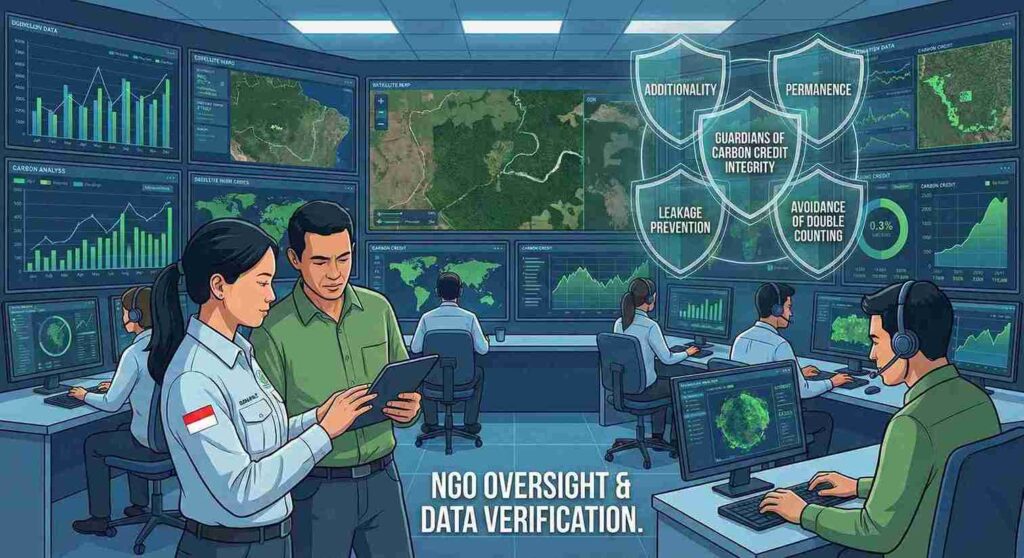
They ensure key principles are met:
- Additionality
- Permanence
- Leakage prevention
- Avoidance of double counting
3. Community & Indigenous Rights Protectors
NGOs safeguard land tenure, Free Prior and Informed Consent (FPIC), and benefit-sharing mechanisms.
4. Policy & Standard Influencers
Many methodologies under Verra, Gold Standard, and Article 6 of the Paris Agreement are shaped by NGO input.
5. Risk Mitigation Partners for Corporations
NGO involvement reduces:
- Legal exposure
- ESG backlash
- Greenwashing allegations
6. Transparency & Accountability Drivers
NGOs demand public disclosure, impact reporting, and third-party verification.
7. Impact Scalability Enablers
Through carbon finance, NGOs can scale conservation from pilot projects to landscape-level impact.
4. NGO–Corporate Collaboration: From CSR to Strategic Partnership
Carbon markets have transformed NGO–corporate relationships.
| Aspect | Traditional CSR | Carbon Market Partnership |
|---|---|---|
| Duration | Short-term | Long-term (10–30 years) |
| Value | Philanthropy | Shared value & impact |
| Accountability | Low | High (MRV-based) |
| Risk Management | Minimal | Strategic ESG mitigation |
This evolution reflects a shift from image-based sustainability to performance-based climate action.
5. Market Trend: Quality Over Quantity in Carbon Credits
The VCM is moving away from volume-driven trading toward high-quality, high-integrity credits.
Key Market Signals
- Lower transaction volumes
- Higher demand for premium credits
- Strong preference for nature-based and removal credits
Carbon Credit Demand Trend

High Quality Credits   ████████████
Medium Quality Credits ███████
Low Quality Credits    ███
NGOs play a decisive role in defining and delivering these premium credits.
6. Why This Matters for Business, ESG, and Sustainability Leaders
For organizations engaged in the Global Carbon Market or VCM, NGO collaboration is no longer optional.
Benefits include:
- Stronger ESG credibility
- Defensible net-zero claims
- Reduced reputational and legal risk
- Access to trusted, high-integrity carbon credits
Carbon strategies without NGO involvement increasingly fail market scrutiny.
7. Capacity Building: The Missing Link in Carbon Market Readiness
Despite rapid market growth, many professionals still lack:
- Practical understanding of carbon mechanisms
- Knowledge of international standards
- Skills to evaluate credit quality
This gap creates operational and reputational risk.
Build Credible Carbon Competence with Mutu Institute
To navigate the evolving Global Carbon Market and VCM, organizations need more than ambition—they need competence.
Mutu Institute provides:
- Practical carbon market training
- ESG and sustainability capacity building
- Applied understanding of carbon standards and governance
Supported by NGO Carbon Nature, Mutu Institute integrates:
- Scientific rigor
- Community-based approaches
- International best practices
This combination ensures learning is not theoretical, but operational and credible.
Strengthen your carbon strategy. Build trust. Avoid greenwashing.
Frequently Asked Questions (FAQ)
What is the difference between the Global Carbon Market and VCM?
The Global Carbon Market includes both mandatory (compliance) and voluntary systems, while VCM refers specifically to voluntary carbon credit trading.
Are NGOs anti–carbon market?
No. Most NGOs now support reformed, high-integrity carbon markets, not uncontrolled or low-quality offsetting.
Why do companies need NGOs in carbon projects?
NGOs provide legitimacy, social safeguards, monitoring credibility, and risk mitigation.
Are carbon credits still relevant for net-zero?
Yes, but only when used after internal emission reductions and sourced from high-quality, transparent projects.
How can professionals prepare for carbon market engagement?
Through structured training, applied knowledge, and partnerships with credible institutions like Mutu Institute.
Stay connected with us for more insights, updates, and sustainability knowledge. Follow our official channels:
Instagram: carbonature_
YouTube: CarbonNature
Facebook: Carbon Nature
Website: www.carbonnature.com
For training inquiries, partnership opportunities, or direct assistance, contact us at:
Email: info@carbonnature.com
Phone/WhatsApp: 0819-1880-0012
We’re here to support your journey toward stronger sustainability performance and real climate impact.