

Indonesia is no longer “preparing” for the carbon economy. It has entered it. Quietly, structurally, and with enormous implications.
With the launch of carbon trading through Bursa Efek Indonesia (IDXCarbon), Indonesia signaled something bigger than climate compliance. It signaled market formation.
This is not about saving the planet.
This is about who captures the value of decarbonization.
Carbon Is the New Commodity
For decades, Indonesia monetized coal, nickel, palm oil. Now a new asset class is forming: carbon.
Under the supervision of:
- Kementerian Lingkungan Hidup dan Kehutanan
- Kementerian Energi dan Sumber Daya Mineral
- Otoritas Jasa Keuangan
Indonesia has built the regulatory spine for a functioning carbon market.
But here’s the real shift:
Carbon is transitioning from regulatory burden to strategic leverage.
Companies that understand this early will not just comply — they will accumulate.
Net Zero 2060 Is a Market Signal, Not a Moral Statement
Indonesia’s Net Zero Emission 2060 target is widely framed as environmental commitment. That framing is incomplete.
Net zero is a macroeconomic restructuring signal.
It means:
- Capital will move toward low-carbon assets
- High-emission operations will face escalating costs
- ESG-linked financing will tighten
- Carbon disclosure will become mandatory infrastructure
The companies waiting for “clearer rules” are already late.
The Untold Advantage: Indonesia Could Dominate Nature-Based Carbon
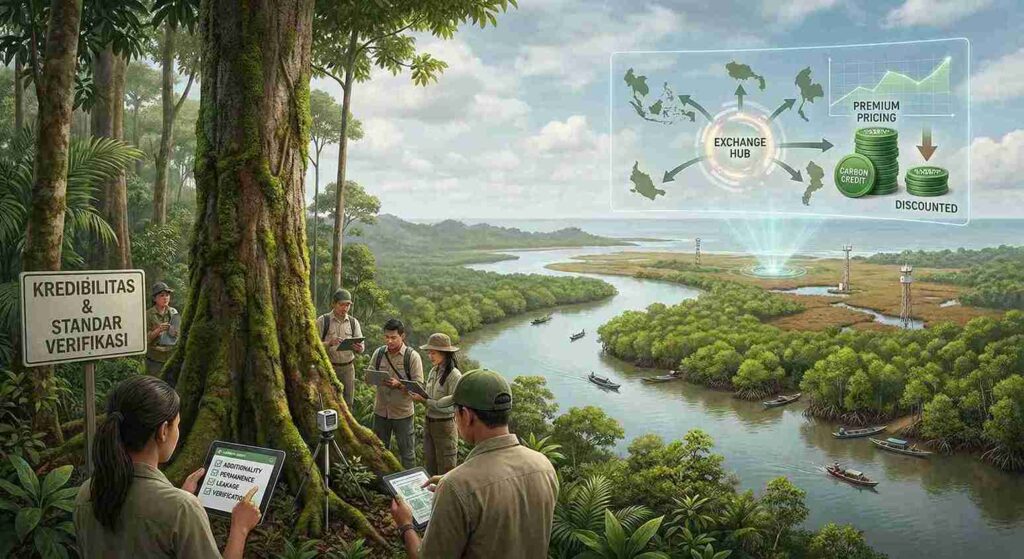
Indonesia holds structural dominance in:
- Tropical forests
- Peatlands
- The world’s largest mangrove ecosystems
If properly verified and standardized, nature-based credits from Indonesia could command global premium pricing.
The problem is not potential.
The problem is credibility.
Global buyers increasingly scrutinize:
- Additionality
- Permanence
- Leakage
- Verification standards
If Indonesia raises integrity standards aggressively, it could position itself as Southeast Asia’s carbon clearinghouse.
If it fails, credits will trade at a discount.
IDXCarbon Is Just Phase One
The launch of carbon trading on Bursa Efek Indonesia is not the climax. It is the infrastructure layer.
Phase Two will determine dominance:
- Expansion beyond the power sector
- Integration with international carbon markets
- Financial derivatives based on carbon units
- Institutional investor participation
When carbon becomes bankable collateral, the game changes entirely.
The Brutal Reality: Most Companies Are Not Ready
Boardrooms talk sustainability.
Few understand carbon accounting at a strategic level.
Scope 1, 2, and especially Scope 3 emissions remain misunderstood across industries.
The gap is widening between:
- Companies building internal carbon intelligence
- Companies treating sustainability as PR
In five years, this gap will be visible in valuation multiples.
Who Wins This Carbon Transition?
- Early project developers securing high-quality land assets
- Corporations locking long-term carbon supply at low prices
- Financial institutions structuring carbon-linked instruments
- Auditors and verifiers controlling integrity standards
Who loses?
Companies that assume carbon is just another compliance line item.
Stay connected with us for more insights, updates, and sustainability knowledge. Follow our official channels:
Instagram: carbonature_
YouTube: CarbonNature
Facebook: Carbon Nature
Website: www.carbonnature.com
For training inquiries, partnership opportunities, or direct assistance, contact us at:
Email: info@carbonnature.com
Phone/WhatsApp: 0819-1880-0012
We’re here to support your journey toward stronger sustainability performance and real climate impact.
Frequently Asked Questions (FAQ) — Indonesia’s Carbon Market
1. What is Indonesia’s carbon market?
Indonesia’s carbon market is a regulated system that allows companies to trade carbon units to offset or comply with emission limits. It operates under national oversight and is facilitated through Bursa Efek Indonesia via the IDXCarbon platform.
It is designed to:
- Reduce national greenhouse gas emissions
- Create economic value from carbon reduction projects
- Support Indonesia’s Net Zero 2060 target
2. What is IDXCarbon?
IDXCarbon is the official carbon exchange platform operated by Bursa Efek Indonesia.
It enables:
- Trading of verified carbon units
- Transparent pricing mechanisms
- Compliance and voluntary market participation
Initially, it focuses on the power generation sector, particularly coal-fired plants.
3. Who regulates carbon trading in Indonesia?
Carbon regulation involves multiple authorities:
- Kementerian Lingkungan Hidup dan Kehutanan – Environmental authority and carbon registry oversight
- Kementerian Energi dan Sumber Daya Mineral – Sectoral emission control (energy)
- Otoritas Jasa Keuangan – Financial market supervision
This multi-agency structure ensures regulatory, technical, and financial alignment.
4. What is a carbon credit?
A carbon credit represents one metric ton of CO₂ (or equivalent greenhouse gas) reduced or removed from the atmosphere.
In Indonesia, credits can be generated from:
- Renewable energy projects
- Forest conservation
- Peatland restoration
- Mangrove protection
These credits must be verified and registered before being traded.
5. Is carbon trading mandatory in Indonesia?
For certain sectors, particularly power generation, compliance mechanisms apply. Other sectors may participate voluntarily.
Over time, coverage is expected to expand, increasing mandatory participation across industries.
6. How can companies participate in Indonesia’s carbon market?
Companies can participate by:
- Reducing internal emissions
- Purchasing carbon credits via IDXCarbon
- Developing carbon reduction projects
- Registering projects in the national carbon registry
Participation requires proper carbon accounting and verification.
7. What is the difference between compliance and voluntary carbon markets?
Compliance market:
- Required by regulation
- Targets specific sectors
- Enforced emission caps
Voluntary market:
- Companies offset emissions beyond legal requirements
- Often driven by ESG commitments
- Used for corporate sustainability strategies
Indonesia supports both mechanisms.
8. Why is Indonesia strategically important in the global carbon market?
Indonesia holds significant natural carbon assets, including tropical forests and the world’s largest mangrove ecosystems. This gives it strong potential in nature-based carbon solutions.
If integrity and verification standards remain strong, Indonesia could become a regional carbon hub in Southeast Asia.
9. What are the risks in Indonesia’s carbon market?
Key risks include:
- Credit quality and additionality concerns
- Price volatility
- Regulatory adjustments
- International acceptance of domestic credits
Market maturity and strong governance are critical to long-term credibility.
10. Is carbon trading a financial opportunity or just compliance?
It is both.
For some companies, carbon trading is a regulatory obligation. For others, it is an emerging asset class and strategic hedge against future carbon pricing.
As the market deepens, carbon may function similarly to other tradable commodities with investment value.