

Indonesia’s Carbon Market Has Entered the Implementation Phase
Indonesia carbon market is no longer a long-term policy discourse. It has entered a concrete implementation stage, supported by evolving regulations, carbon trading initiatives, and national commitments to emission reduction targets. Government frameworks, digital platforms, and market mechanisms are increasingly in place.
However, behind regulatory readiness and system development, one fundamental question remains largely unanswered: are human resources truly prepared to operate Indonesia’s carbon market effectively?
This question is not theoretical. Across sectors, organizations are beginning to realize that carbon market success is not determined by regulation alone, but by the competence of the people responsible for translating policy into measurable, verifiable action.
The Indonesia Carbon Market Is Not Just a Mechanism, but a Competency Challenge
Many organizations still perceive the Indonesia carbon market as an administrative obligation rather than a strategic competency. In practice, carbon schemes demand multidisciplinary expertise that goes far beyond environmental awareness.
Effective participation in carbon trading Indonesia requires:
- Accurate greenhouse gas emission calculation
- Establishment of credible baselines and additionality
- Robust Monitoring, Reporting, and Verification (MRV) systems
- Understanding of applicable standards and regulatory frameworks
- Awareness of carbon market dynamics, pricing, and compliance risks
Without adequate carbon market readiness, organizations face recurring problems such as inconsistent emission data, weak documentation, and failed verification processes. These issues directly reduce credibility and limit access to carbon market opportunities.
Real Challenges in the Field: A Common Pattern Across Sectors
Field observations across energy, forestry, agriculture, and industrial sectors reveal similar human resource constraints in Indonesia’s carbon market implementation.
1. Fragmented Understanding of Carbon Schemes
Many professionals understand individual components of carbon schemes but lack a holistic view of the full process. This results in disconnected workflows and operational inefficiencies.
2. Inconsistent Emission Calculations
Emission calculations are often performed partially, using different assumptions and methodologies. This inconsistency creates significant risks during validation and verification stages.
3. Weak Documentation and Reporting Practices
Documentation is frequently prepared only when verification is imminent, rather than being embedded as a continuous operational process. As a result, organizations struggle to meet MRV carbon requirements.
4. Limited Familiarity with Standards and Regulations
Carbon standards and regulatory mechanisms evolve rapidly. Without structured learning, many teams operate using outdated references, increasing compliance risks.
These challenges confirm that Indonesia carbon market readiness cannot rely solely on regulatory instruments or digital platforms. Human capital capacity remains the decisive factor.
Human Resources as the Key Determinant of Carbon Market Success
In the Indonesia carbon market, human resources are not supporting actors; they are central to the system. Professionals who understand technical concepts, interpret regulations correctly, and manage data with integrity determine whether carbon schemes become operational assets or organizational liabilities.
Organizations with competent carbon teams demonstrate:
- Higher success rates in verification and certification
- Reduced compliance and reputational risks
- Better positioning to monetize carbon assets
- Stronger credibility with regulators, verifiers, and market participants
This reality places human capital development at the core of carbon market strategy.
Why Investing in Carbon Competency Is No Longer Optional
As carbon trading Indonesia matures, competition will increasingly be driven by capability rather than access. Organizations that delay capacity building risk falling behind, even if regulatory access remains open.
Investing in structured carbon training Indonesia offers tangible benefits:
- Improved operational efficiency in MRV carbon processes
- Greater confidence during audits and verification
- Stronger internal coordination across departments
- Enhanced ability to identify and optimize carbon opportunities
Carbon market readiness is not achieved through ad hoc learning. It requires systematic, practice-oriented competency development.
Preparing Early: A Strategic Advantage in the Indonesia Carbon Market
Organizations that prepare their human resources early gain a significant adaptation advantage. Early readiness allows teams to internalize carbon concepts, anticipate regulatory changes, and embed carbon considerations into daily operations.
Rather than reacting to compliance demands, prepared organizations proactively position themselves within the carbon market ecosystem. This shift transforms carbon schemes from perceived burdens into strategic opportunities.
Building Practical Readiness Through Structured Training
This is where structured training becomes critical. Effective carbon training Indonesia should not focus solely on theory, but on applied understanding that reflects real operational conditions.
MUTU Institute delivers comprehensive carbon market training programs designed to strengthen practical competence across the entire carbon value chain. The programs address:
- End-to-end carbon scheme understanding
- Emission calculation and baseline development
- MRV carbon system implementation
- Regulatory interpretation and compliance readiness
- Practical case studies aligned with Indonesia carbon market conditions
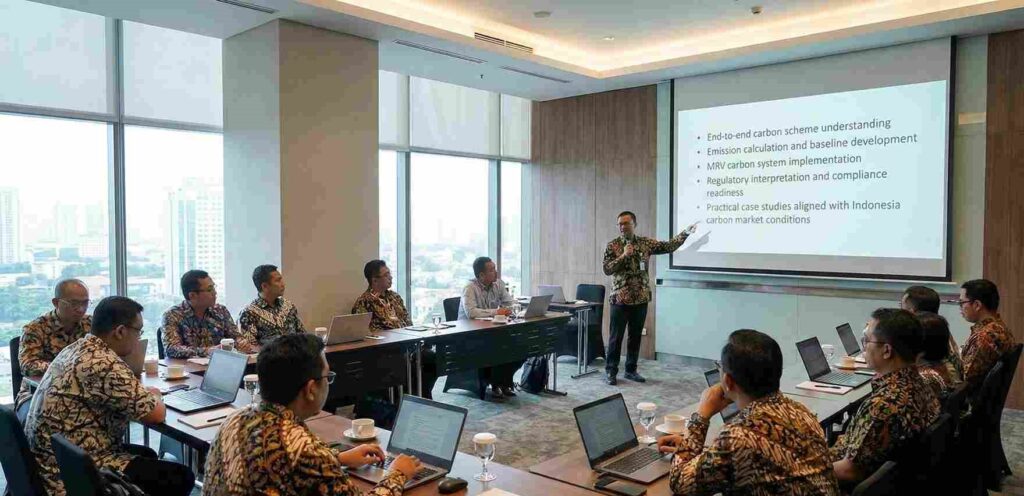
The training approach emphasizes applicability, ensuring participants can immediately translate knowledge into operational improvements.
Carbon Nature as an NGO-Based Implementation Partner
In addition to training, organizations often require technical and strategic support during implementation. Through Carbon Nature, an NGO-based service under MUTU Institute, organizations gain access to independent, mission-driven assistance in carbon project development and management.
Carbon Nature supports:
- Capacity building for community-based and organizational carbon initiatives
- Technical assistance in project preparation and MRV systems
- Alignment between environmental integrity and market viability
This integrated ecosystem enables organizations not only to comply, but to contribute meaningfully to sustainable carbon market development.
The Indonesia Carbon Market Is a Human Capital Test
The future of the Indonesia carbon market will be determined not by the sophistication of regulations or trading platforms, but by the readiness of the people who operate them. Human resources with strong carbon competencies are the foundation of credible, effective, and sustainable carbon market participation.
Organizations that invest early in carbon market readiness through structured training and strategic support will be better positioned to navigate complexity, manage risks, and unlock long-term value.
The carbon market is moving forward. The question is no longer whether to prepare, but how soon.
Stay connected with us for more insights, updates, and sustainability knowledge. Follow our official channels:
Instagram: carbonature_
YouTube: CarbonNature
Facebook: Carbon Nature
Website: www.carbonnature.com
For training inquiries, partnership opportunities, or direct assistance, contact us at:
Email: info@carbonnature.com
Phone/WhatsApp: 0819-1880-0012
We’re here to support your journey toward stronger sustainability performance and real climate impact.