

When Illegal Logging Turns Climate Risk Into Human Tragedy
Timber Laundering – Indonesia’s forestry sector is once again under global scrutiny after authorities uncovered a large-scale timber-laundering network in North Sumatra. What initially appeared to be a routine enforcement case has expanded into a complex investigation involving multiple land-rights holders, suspected permit violations, and organised illegal timber flows entering the legal supply chain.
This revelation comes in the aftermath of Cyclone Senyar, whose floods and landslides killed nearly 1,000 people and displaced hundreds of thousands across Sumatra. Investigators now believe that upstream forest degradation and accumulated logging debris significantly amplified the disaster’s impact.
The case highlights a critical reality:
Illegal logging is no longer just an environmental crime — it is a direct threat to public safety, climate resilience, and national economic integrity.
Key Findings: A Timber-Laundering Network Uncovered
Indonesia’s Directorate General of Forestry Law Enforcement confirmed that the investigation began with a land-rights holder identified as JAM, suspected of harvesting forest products without valid permits. Under Law No. 41/1999 on Forestry, such violations carry penalties of up to five years’ imprisonment and fines reaching Rp3.5 billion (US$210,000).
However, enforcement teams soon discovered that the activity was not isolated.
Three PHAT Holders Under Investigation
The probe has expanded to include two additional land-rights (PHAT) holders:
- M, allegedly receiving logs sourced from illegal operations
- AR, accused of logging beyond its approved concession boundaries
Satellite imagery revealed approximately 33 hectares of suspected illegal logging in the upstream area of the Batang Toru River, a critical watershed in North Sumatra.
Officials allege that AR used a classic timber-laundering technique: mixing illegally harvested logs with legally sourced timber, allowing the wood to pass through official documentation systems and enter the formal supply chain undetected.
According to Yazid Nurhuda, Director of Forestry Prevention and Complaint Management, the pattern strongly indicates organised and systematic activity, not individual violations.
Timber Laundering: How Illegal Wood Enters Legal Markets
Timber laundering remains one of the most persistent challenges in forest governance. The process typically involves:
- Harvesting timber illegally outside permitted areas
- Transporting logs to legal concessions or processing sites
- Mixing illegal timber with documented wood
- Using valid transport documents to legitimise the entire shipment
This practice undermines Indonesia’s legal timber trade system, weakens certification credibility, and erodes trust in sustainable forest management frameworks.
Director General of Forestry Law Enforcement Dwi Januanto Nugroho emphasised that enforcement now targets not only field operators but also networks, facilitators, and permit holders who enable illegal timber to circulate through formal channels.
From Enforcement to Policy: 22 Forestry Permits Revoked Nationwide
The government response has gone beyond criminal investigations.
On December 15, Forestry Minister Raja Juli Antoni announced the revocation of 22 forestry permits nationwide, covering more than one million hectares of forestland. Over 100,000 hectares of these permits are located in Sumatra.
This decision follows earlier actions in February, when permits covering approximately 500,000 hectares were cancelled. In total, Indonesia has now regulated or reclaimed 1.5 million hectares of forest area in 2025 alone.
Environmental experts widely agree that extensive forest loss played a major role in the severity of recent floods and landslides, which devastated communities across north-western Sumatra.
Why Forest Loss Turns Heavy Rain Into Disaster
Forests are not passive landscapes. They perform essential ecological functions, including:
- Absorbing and slowing rainfall
- Stabilising soil and preventing erosion
- Regulating river flow and sediment movement
When forests are degraded, watersheds lose their buffering capacity. During extreme weather events, rainwater rushes downstream unchecked, carrying mud, debris, and, in this case, large volumes of loose timber.
Authorities confirmed that during Cyclone Senyar, logs were swept downstream, destroying homes, bridges, and public infrastructure across Aceh, North Sumatra, and West Sumatra.
Indonesia’s Forest Loss in Numbers
Despite progress in policy reform, Indonesia remains one of the world’s largest contributors to annual forest loss. According to The TreeMap’s Nusantara Atlas project:
- More than 240,000 hectares of primary forest were lost in 2024
- Major drivers include mining, plantations, fires, and land-use conversion
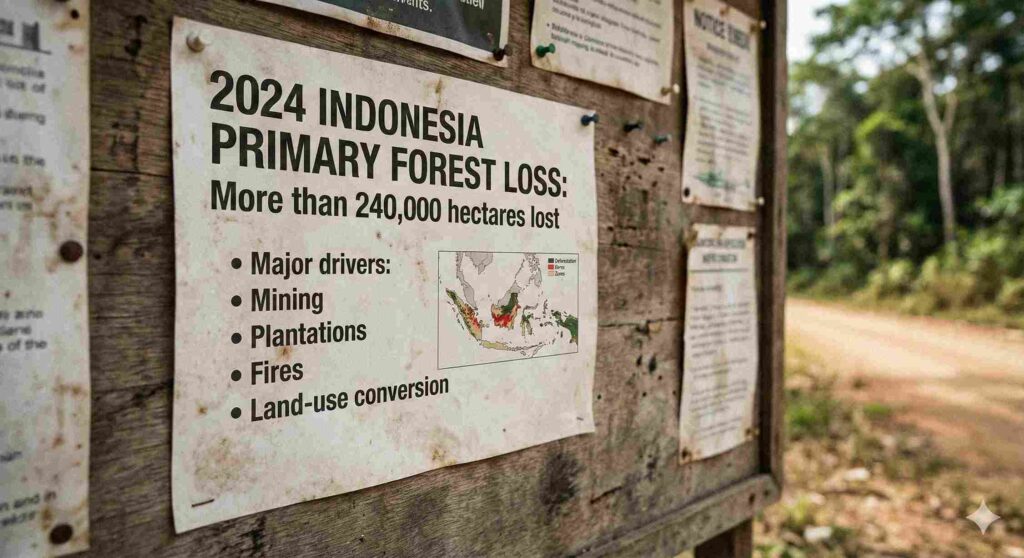
The latest timber-laundering revelations reinforce concerns that governance gaps, weak monitoring, and limited human-resource capacity continue to undermine sustainable forest management.
Emergency Measures: Logging Suspensions and Moratoriums
In response to the disaster, authorities imposed an emergency moratorium on all timber harvesting and transport across:
- Aceh
- North Sumatra
- West Sumatra
Under this directive, forestry companies are required to:
- Revise operational work plans
- Secure existing timber stockpiles
- Clear waterways of debris
- Ensure flood-control infrastructure is functional
Forestry Minister Raja Juli Antoni confirmed that four corporations and seven PHAT holders are now under investigation, with several already facing prosecution. Field teams have seized logs, heavy machinery, and evidence of unauthorised harvesting at multiple locations.
Governance Gaps and the Human Factor
Environmental advocates argue that the tragedy exposes long-standing weaknesses in forest governance.
“Logs don’t just fall from the sky — they must have come from logging activities upstream,” said Walden Sitanggang, an environmental activist quoted by the New York Times.
At the core of the issue is not only regulation, but implementation quality. Policies, permits, and monitoring systems are only as effective as the people responsible for applying them in the field.
This is where human resource capacity, technical competence, and ethical leadership become decisive.
Why Competent Forestry Professionals Matter More Than Ever
As climate risks intensify, forestry professionals face higher expectations:
- Accurate permit management
- Strong understanding of legal boundaries
- Transparent timber-tracking systems
- Proactive risk mitigation in watersheds
Without continuous training and professional development, even well-designed regulations can fail at the operational level.
Strengthening capacity is no longer optional — it is a risk-management necessity.
Soft Path Forward: Building Capacity, Not Just Punishment
While law enforcement remains essential, sustainable solutions require parallel investment in:
- Training and certification of forestry personnel
- Audit readiness and compliance systems
- Early-warning mechanisms using satellite and field data
- Collaboration between government, industry, NGOs, and communities
This balanced approach helps prevent violations before they escalate into environmental and humanitarian crises.
Strengthen Your Forestry Governance Today
At Mutu Institute, we support organisations, forestry companies, and professionals in strengthening competence, compliance, and credibility across the forestry sector. Our training programs focus on:
- Sustainable forest management
- Audit, verification, and performance readiness
- Legal compliance and risk mitigation
- Practical implementation aligned with national regulations
In parallel, through our NGO initiative Carbon Nature, we work with communities, organisations, and partners to promote forest conservation, carbon protection, and nature-based solutions that deliver real environmental and social impact.
If your organisation is committed to responsible forestry, climate resilience, and long-term sustainability, now is the time to invest in capacity building and credible action.
Follow Mutu Institute’s training programs and collaborate with Carbon Nature to be part of the solution — not the next headline.
Stay connected with us for more insights, updates, and sustainability knowledge. Follow our official channels:
Instagram: carbonature_
YouTube: CarbonNature
Facebook: Carbon Nature
Website: www.carbonnature.com
For training inquiries, partnership opportunities, or direct assistance, contact us at:
Email: info@carbonnature.com
Phone/WhatsApp: 0819-1880-0012
We’re here to support your journey toward stronger sustainability performance and real climate impact.