

Introduction: ASEAN Steps Up Blue Climate Action
Blue Carbon – The Association of Southeast Asian Nations (ASEAN), the Government of Japan, and the United Nations Development Programme (UNDP) convened the ASEAN Regional Workshop on Blue Carbon and Finance Profiling on 27–28 November in Jakarta. The meeting reflected a collective push to strengthen the science and policy foundation behind coastal and freshwater climate action in Southeast Asia—a region rich in blue carbon ecosystems yet facing growing environmental pressures.
Hosted by the Ministry of National Development Planning (BAPPENAS), this workshop is part of the ASEAN Blue Carbon and Finance Profiling (ABCF) Project, a Japan-funded regional programme implemented by UNDP Indonesia in collaboration with the ASEAN Coordinating Task Force on Blue Economy (ACTF-BE). The initiative aims to map ecosystem conditions, quantify economic value, and build financial pathways that can unlock investment for coastal protection and restoration across ASEAN.
Strengthening Blue Carbon Knowledge Across the Region
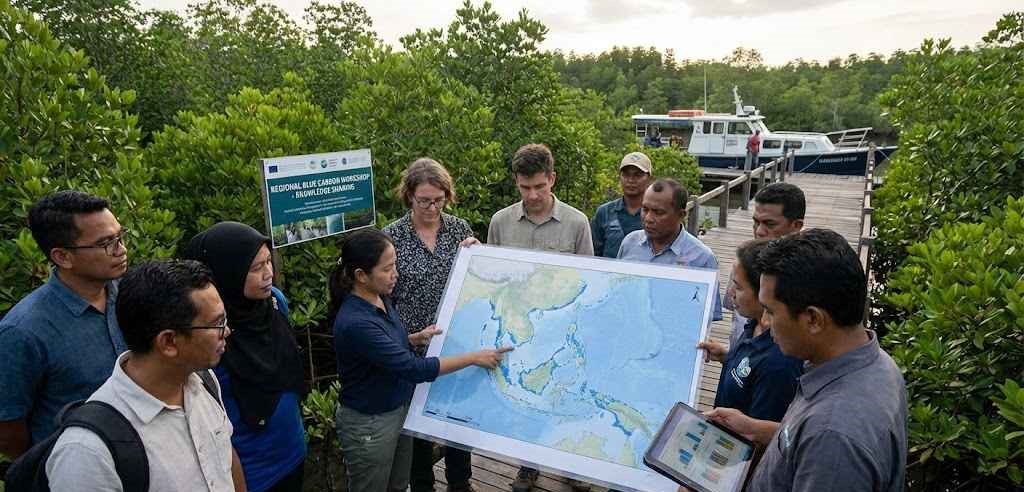
Blue carbon ecosystems—mangroves, seagrass meadows, and peatlands—play an outsized role in climate mitigation and adaptation. They store vast amounts of carbon, support fisheries, protect coastlines, and sustain millions of livelihoods. Yet they are increasingly threatened by land conversion, pollution, unsustainable development, and climate-driven impacts.
To close knowledge gaps, 30 technical experts from 11 ASEAN Member States convened in Jakarta to align data standards, methodologies, and valuation approaches. The workshop focused on shaping:
- 11 National Blue Carbon Profiles
- 11 National Blue Finance Profiles
- Two Regional Blue Carbon and Blue Finance Profiles
These deliverables—expected to launch in March 2026—will give ASEAN governments a unified reference for understanding ecosystem condition, carbon stock potential, and financing needs. The profiles are designed to strengthen policymaking, guide climate strategies, and direct investment into sustainable blue economy sectors.
Building Practical Tools for Policy and Investment
Throughout the two-day meeting, participants engaged in exchanges on:
- Data integration and standardization
- Ecosystem valuation methodologies
- Carbon modelling and monitoring tools
- Financing frameworks and policy enabling conditions
- Investment pathways, including public, private, and blended finance
The objective is clear: develop practical, user-friendly tools usable by both policymakers and investors to accelerate coastal protection and restoration efforts.
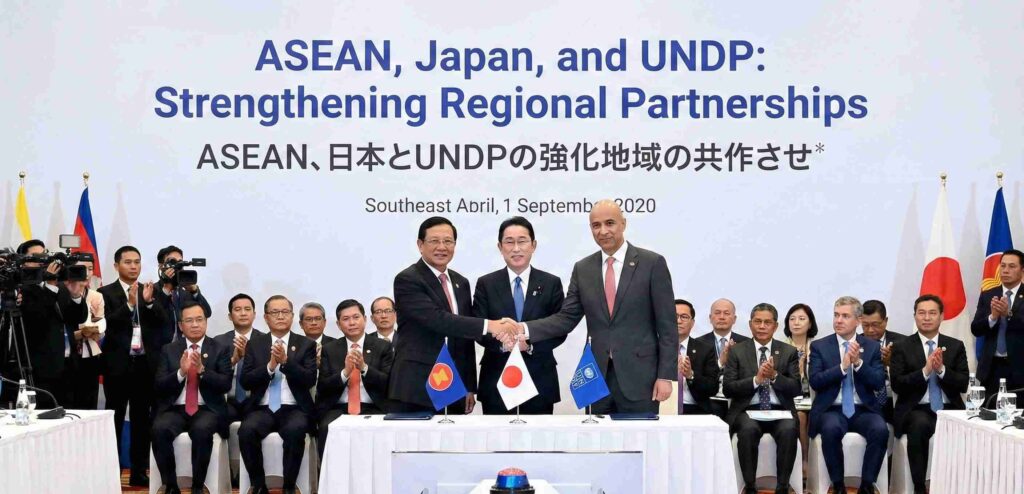
ASEAN, Japan, and UNDP: Strengthening Regional Partnerships
ASEAN Leadership
Speaking on behalf of ASEAN as the Shepherd of ACTF-BE, Dr. Eka Chandra Buana, Deputy Minister for Macro Development Planning of BAPPENAS, emphasized that advancing blue carbon and blue finance is a core pillar of the ASEAN Blue Economy agenda. He highlighted the importance of collective knowledge creation and cross-country collaboration to drive sustainable development across the region.
Japan’s Commitment to ASEAN’s Blue Economy
Representing the Government of Japan, Mr. Chujo Kazuo, Minister/Deputy Chief of Mission to ASEAN, underscored Japan’s long-standing partnership with the region. He stressed that expertise must be rooted in local knowledge and regional ownership. Japan views this project as a catalyst for:
- Protecting vital ecosystems
- Strengthening climate resilience
- Creating sustainable economic opportunities
- Enhancing regional prosperity and security
UNDP’s Technical Leadership
UNDP Indonesia Deputy Resident Representative, Ms. Sujala Pant, highlighted the scientific depth behind the profiling effort, with 98 experts from 35 academic and research institutions contributing to the work. She noted that the workshop served as a collaborative environment to refine assumptions, strengthen analytical linkages between carbon and finance components, and identify regional patterns.
Closing Gaps in Data, Policy, and Finance
Despite their value, blue carbon ecosystems often lack comprehensive data and clear economic valuation—key barriers to effective policymaking and investment. The ABCF Project addresses these barriers by:
- Mapping ecosystem extent and condition
- Quantifying carbon stock and sequestration potential
- Identifying enabling policy frameworks
- Outlining financing strategies—including innovative mechanisms such as blue bonds, blended finance, and results-based payments
By generating standardized national and regional profiles, the project aims to elevate blue carbon within national climate strategies and boost investment into nature-based solutions across ASEAN.
Positioning ASEAN for a Resilient and Inclusive Blue Economy
The ABCF initiative is part of the broader Japan–ASEAN Blue Economy Cooperation, which supports:
- Cross-border knowledge exchange
- Scaled implementation of nature-based climate solutions
- Long-term resilience of coastal communities
- Growth of sustainable and inclusive blue economy sectors
By connecting science, policy, and finance, the workshop marks a significant step toward a more climate-resilient future for the region’s coastal ecosystems.
Why Blue Carbon Matters for ASEAN’s Future
Blue carbon ecosystems are among the world’s most efficient natural carbon sinks—yet they represent far more than climate mitigation tools. They:
- Store up to four times more carbon than terrestrial forests
- Protect coastlines from storm surge and erosion
- Support food security through productive fisheries
- Provide livelihoods for millions
- Enhance biodiversity and ecological stability
As ASEAN accelerates its transition toward a sustainable blue economy, science-based policymaking and finance-ready data become essential tools for long-term regional resilience.
Strengthen Your Expertise with Mutu Institute
Organizations and professionals working in climate, environment, or blue economy sectors can amplify their impact through specialized training.
Mutu Institute offers comprehensive training programmes related to environmental management, climate standards, and sustainability frameworks—supporting individuals and institutions to build strong technical capabilities aligned with ASEAN’s evolving policy landscape.
Mutu Institute also operates an environmental NGO, Carbon Nature, focused on advancing ecosystem restoration, climate research, and community-based nature solutions.
If your institution plans to engage in blue carbon, coastal restoration, climate finance, greenhouse gas accounting, or sustainability certification systems, joining our training programmes will help you:
- Strengthen technical competence
- Align with national and regional climate policies
- Improve project design and implementation
- Enhance readiness for investment, certification, and reporting
For training inquiries, programme schedules, or collaboration opportunities, contact Mutu Institute. Together, we can support stronger climate action and a more resilient blue economy across ASEAN.